Home › Knowledge › Medicare Advantage
2026 Medicare Annual Enrollment Period: Massive Changes to Drive Consumer Action
Vedanth Bhartee
Writer · Reviewed by Richard ChanUpdated Jun 12, 2026
6 min read
Key Takeaways
The Medicare Annual Enrollment Period runs annually from October 15 to December 7.
During the enrollment period, beneficiaries can switch, drop, or enroll in Medicare Advantage and Part D prescription drug plans.
Changes made during the Annual Enrollment Period take effect on January 1 of the following year.
Navigating the Medicare Annual Enrollment Period (AEP)—which runs from October 15 through December 7—can often feel like making your way through a maze. But this year, it’s especially critical to pay attention. Significant shifts are reshaping the healthcare landscape, particularly when it comes to Medicare Advantage (MA) and Part D prescription drug plans. We know managing these changes on top of your health and finances is incredibly stressful, so here is what you need to know to navigate this upcoming enrollment season with confidence.
According to recently released data from the Centers for Medicare & Medicaid Services (CMS), the pool of traditional Medicare Advantage plans is shrinking. Standalone Part D options are also dwindling, experiencing a striking 22% reduction in available choices compared to the previous year. This pullback is largely driven by mounting financial pressures on insurers, such as reduced government reimbursements and the ever-rising cost of healthcare.
Because your health—and your wallet—are on the line, we’ve broken down exactly what you need to know to stay prepared during this Medicare AEP.
Traditional Medicare Advantage Plans Are Shrinking—Here’s What That Means for You
If you’re currently relying on a traditional Medicare Advantage (MA) plan, such as a Health Maintenance Organization (HMO) or Preferred Provider Organization (PPO), you’ll want to review your options carefully. Major insurance companies are pulling back on their offerings for 2026, and these cutbacks could directly impact both your out-of-pocket costs and your access to preferred doctors.
What’s Changing?
- HMO Plans: You can expect to see a 7% reduction in HMO plans heading into 2026, which leaves consumers with roughly 135 fewer options. When compared to the market landscape just a couple of years ago, this represents a broader 14% decline, translating to about 302 lost plans.
- PPO Plans: PPO shoppers are facing even steeper cuts. These plans are experiencing a 12% decrease (around 190 plans) for the upcoming year, and a significant 16% drop (approximately 275 plans) compared to previous baseline levels.
- Standalone Part D Plans: Perhaps the most concerning contraction is happening in the standalone Part D prescription drug market. These options are seeing a steep 31% reduction year-over-year and an overall 47% decrease compared to recent years. In practical terms, nearly half of all available Part D choices have disappeared in the span of just two years.
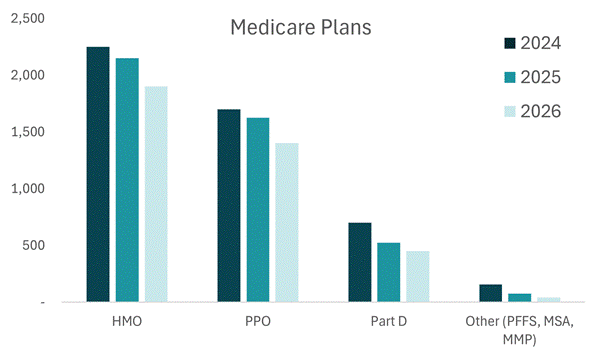
Source: CMS Landscape files 2026 – Medicare Plans (excl. Special Needs Plans)
Why Is This Happening?
You might be wondering why your safety net is shrinking. A few major industry shifts are responsible for the squeeze:
- Financial Pressures on Insurers: As healthcare costs skyrocket and government reimbursements decrease, insurance companies are tightening their belts. Unsurprisingly, this means they are abandoning less profitable regions and plan structures.
- Market Consolidation: Some heavyweight carriers are choosing to walk away from entire markets. A prime example is Elevance Health, which has completely withdrawn all of its Part D plans for 2026. This marks a total exit from the standalone prescription drug business for the carrier, leaving many enrollees searching for alternatives.
- Increased Focus on Specialized Plans: Insurers are pivoting hard toward Special Needs Plans (SNPs), which are designed for folks with highly specific health needs, like chronic conditions or those who are dual-eligible for both Medicare and Medicaid. While standard options shrink, Dual-eligible Special Needs Plans (D-SNPs) are projected to increase by 12% (+113 plans), and Chronic Condition Special Needs Plans (C-SNPs) are seeing an even more dramatic 46% expansion (+172 plans).
Different States, Different Story
Depending on where you live, you might feel these market ripples differently. Insurance carriers adjust their footprints based on regional profitability. For instance, Texas residents will see a notable boost, with the largest increase in Medicare Advantage plans bringing 44 new offerings in 2026. States like Missouri (+18 plans) and Florida (+18 plans) are also enjoying a healthy bump in options. On the flip side, older adults in Minnesota will bear the brunt of the contractions, losing 26 plans. New York (-25 plans), Colorado (-24 plans), and Indiana (-24 plans) are closely trailing in terms of significant market exits.
This regional volatility is compounded by the complete withdrawal of certain major carriers from specific localized markets—much like Elevance Health’s abrupt exit from the Part D landscape.
The Cost Shifts to Beneficiaries
Medicare Advantage
There is a small silver lining: the average monthly premium for Medicare Advantage (MA) plans is actually projected to dip slightly, moving from $16.40 down to $14.00 in 2026. While 64% of individual MA and MAPD plans currently boast a $0 premium, that figure will edge down slightly to 63% in 2026.
However, the relief on premiums is offset by hidden costs elsewhere. The enrollment-weighted average Maximum Out-of-Pocket (MOOP) limit is creeping up, climbing 5% from $5,688 to $5,950. CMS data indicates that while 65% of current enrollees will experience no change or a welcome decrease in their MOOP, the remaining 35% will be hit with an average jump of $981. It's vital to know your financial exposure: the maximum allowable MOOP across all plans for in-network care in 2026 is a staggering $9,250.
Part D Drug Coverage
Due largely to the sweeping impacts of the Inflation Reduction Act, the cap on Part D out-of-pocket costs is set to increase slightly, shifting from the previous $2,000 threshold up to $2,100 in 2026. Because this cap places a larger financial burden onto the insurance providers themselves, they are actively passing those costs along to you by raising deductibles. According to Medicare Market Insights, the overall enrollment-weighted average drug deductible is soaring from $308 to $417—a painful 35% hike.
Finding a plan that won't charge you upfront for your medications is getting harder, too. The percentage of enrollees enjoying a $0 drug deductible is being slashed in half for the second year in a row. Just a few years ago, 60% of the individual MAPD market featured $0 drug deductibles. That number collapsed to 31% recently, and looking ahead to 2026, a mere 14% of enrollees will be lucky enough to hold onto a $0 drug deductible.
Medicare Supplement
If you depend on Medicare Supplement (Medigap) plans to cover what traditional Medicare doesn't, brace yourself for higher premiums in 2026. Double-digit rate hikes are sadly becoming more of the norm than the exception. This upward pressure on prices is largely fueled by an overall increase in healthcare utilization, unrelenting inflation on medical costs, and the expansion of guaranteed issue periods—which legally require insurers to offer plans to consumers without standard medical underwriting.
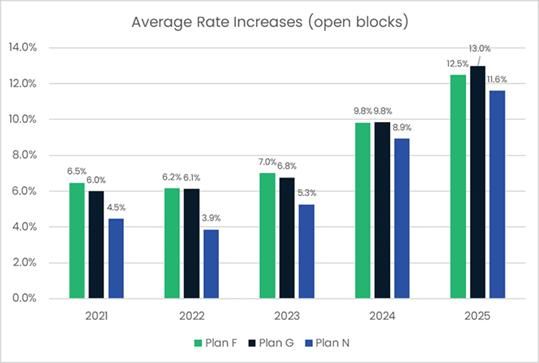
Source: Medicare Market Insights
What Should You Do This Medicare Open Enrollment?
- Review Your Current Plan: Start by thoroughly reading your plan’s Annual Notice of Change (ANOC). It’s the best way to uncover any sneaky modifications to your coverage limits, premium hikes, or dropped doctors in your provider networks.
- Consult Resources: Don’t tackle this alone. Reach out to a trusted insurance agent, broker, or your State Health Insurance Assistance Program (SHIP) for objective, professional guidance on comparing plans and finalizing your enrollment.
- Compare Options: Take the time to actively shop around. Given the massive reductions in traditional plan availability, you cannot simply assume your current coverage will still be the most cost-effective option for your healthcare needs in 2026.