Home › Knowledge › Medicare 101
Medicare?s 8-Minute Rule: What It Means for You
CJ Karrer
Writer · Reviewed by Richard ChanUpdated Jun 12, 2026
7 min read
Key Takeaways
The Medicare 8-Minute Rule is a billing standard that dictates how physical, occupational, and speech therapists bill for time-based outpatient services.
A therapist must provide at least 8 minutes of continuous one-on-one therapeutic service to a patient in order to bill Medicare for a single 15-minute unit.
The rule prevents overbilling by requiring providers to carefully calculate their total treatment time to determine the exact number of billable units.
Recovering from an injury, surgery, or managing a chronic condition through physical therapy is physically and emotionally demanding. The last thing you need during your rehabilitation is confusion over how your healthcare is billed. This is where Medicare's 8-Minute Rule comes into play. While it might sound like an obscure accounting regulation, it is actually a strict billing guideline that determines how physical therapists and other service-based providers are paid for their time. Understanding this rule helps ensure accurate reimbursement and guarantees you are maximizing your Medicare benefits without facing unexpected out-of-pocket costs.
By familiarizing yourself with the 8-Minute Rule and its direct implications on your care, you can become a more empowered patient, ready to handle your Medicare billing and claims with confidence.
Understanding the Medicare 8-Minute Rule
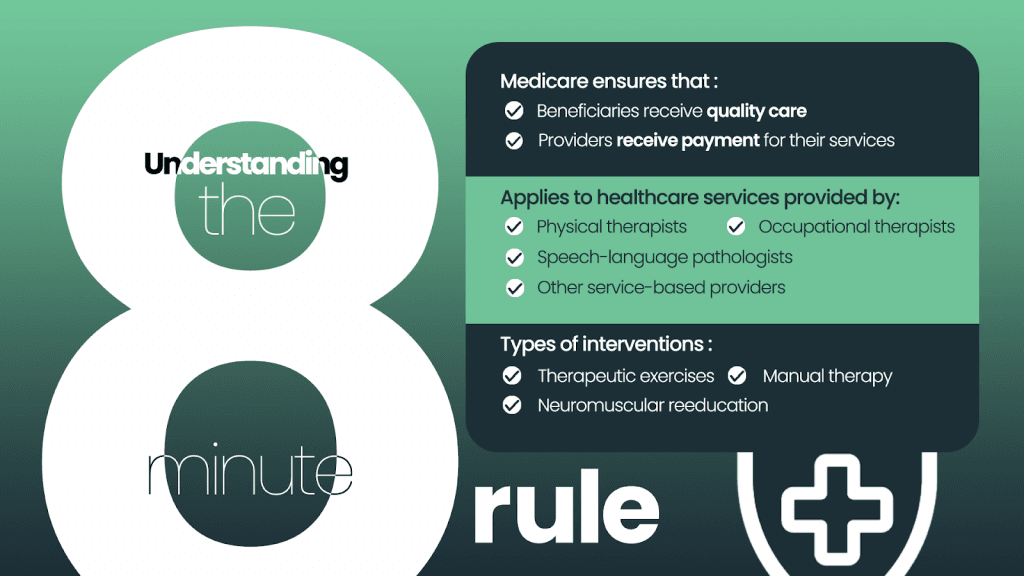
At its core, the Medicare 8-Minute Rule establishes a strict minimum threshold of direct, one-on-one patient care time required before a provider can bill Medicare for a specific service. By enforcing this minimum criterion, Medicare protects beneficiaries from being rushed through incomplete therapy sessions and ensures that healthcare providers are fairly compensated for genuine, dedicated patient care.
This billing standard applies strictly to health services provided by:
- Physical therapists
- Occupational therapists
- Speech-language pathologists
- Other specialized, service-based providers
The services governed by this rule encompass various hands-on interventions, including:
- Guided therapeutic exercises
- Direct manual therapy
- Neuromuscular reeducation techniques
For the rule to apply and for Medicare to issue payment, each specific service block must last a minimum of eight continuous minutes.
Fortunately, the rule acknowledges the reality of fluid, multi-faceted therapy sessions by allowing for cumulative time. This means your therapist can combine minutes spent on different distinct services within a single session to meet the required eight-minute billing unit threshold.
For instance, a physical therapy session will successfully qualify for billing if your therapist spends:
- Five minutes rigorously guiding you through therapeutic exercises, and
- Three minutes administering focused manual therapy during the same session.
Because these two interventions add up to eight minutes of direct care, the cumulative time successfully satisfies Medicare's minimum threshold.
Key Concepts of the 8-Minute Rule
To truly protect your healthcare dollars, it helps to understand the fundamental terminology surrounding Medicare's 8-minute rule.
The Definition of Billable Time
Billable time is exclusively the duration of direct, face-to-face, one-on-one patient care provided by your healthcare professional that qualifies for Medicare reimbursement. The significance of billable time cannot be overstated—it dictates exactly how much your provider is paid. Medicare strictly reimburses providers based on the recorded billable minutes spent actively delivering eligible therapies.
This system is designed to guarantee that providers receive accurate compensation only for the tangible time and clinical effort they dedicate entirely to your recovery.
What Constitutes One-on-One Patient Care?
One-on-one patient care is the cornerstone of effective therapy. It refers to the undivided, personalized attention and direct interaction between you and your healthcare provider during a designated treatment block. It requires the therapist to actively deliver specific healthcare interventions tailored precisely to meet your unique physical limitations and goals.
Medicare fiercely guards the integrity of one-on-one patient care because undivided clinical attention directly correlates with better patient outcomes.
Here are several concrete examples of activities that explicitly qualify as one-on-one patient care under the Medicare 8-Minute Rule:
- Therapeutic Exercises: Carefully monitored physical or occupational therapy exercises aimed at safely improving your strength, flexibility, endurance, balance, or range of motion.
- Manual Therapy: Hands-on techniques performed by physical or occupational therapists to address painful musculoskeletal dysfunctions, such as joint mobilization or targeted soft tissue manipulation.
- Neuromuscular Reeducation: Specialized clinical techniques that focus intensely on restoring or improving your functional movement patterns and physical coordination after an injury or neurological event.
- Modalities: The active, monitored application of therapeutic devices or equipment—such as ultrasound, localized electrical stimulation, or deep heat therapy—specifically designed to alleviate severe pain or aggressively reduce inflammation.
Calculation and Limitations
Calculating billable time under the Medicare 8-Minute Rule is not a guessing game; it requires a highly systematic approach by your provider to ensure legal and accurate reimbursement. Here is how your clinic calculates your billable time:
Step-by-step Guide to Calculating Billable Time
- Identify the eligible services: The provider must clearly separate and identify the specific services administered during your session that are legally eligible for reimbursement under Medicare guidelines.
- Document the time spent: The therapist must meticulously document the exact total time spent on each distinct eligible service. Crucially, this only includes the time spent actively and directly engaging with you during one-on-one care.
- Combine time for cumulative services: If the therapist provides multiple eligible interventions within a single session, they combine the total billable minutes to reach the necessary eight-minute billing units. However, each individual service category must be carefully tracked to ensure accuracy.
- Exclude non-billable activities: Providers must strictly exclude any time spent on non-face-to-face activities. Time spent charting, updating documentation, handling administrative tasks, or resting without therapeutic supervision does not count toward billable care.
- Document and report accurately: Finally, the clinic ensures rock-solid documentation of the billable time for each service, reporting it formally to Medicare to secure legal reimbursement.
Limitations and Exceptions to the Rule
While the Medicare 8-Minute Rule provides a robust framework for billing integrity, it is bound by several strict limitations that protect against fraud:
- Minimum Time Requirement: The absolute foundation of the rule is that a billing unit must meet the eight-minute threshold. A distinct service lasting only six minutes, and not combined with another eligible therapy, will not be paid by Medicare.
- Cumulative Time Calculation: While cumulative time is permitted, it is heavily regulated. You cannot simply lump all distinct services together randomly; some specialized therapies have unique guidelines or absolute restrictions prohibiting them from being grouped into cumulative time calculations.
- Non-Qualifying Activities: Any clinical time spent on non-qualifying activities—such as filling out paperwork, bathroom breaks, or waiting for a therapist to arrive—is strictly forbidden from counting toward your billable time.
Impact of Modifiers on the Rule's Application
In the complex world of medical billing, modifiers are specialized codes used to communicate specific, nuanced information about the services provided. These small codes can drastically impact how the Medicare 8-Minute Rule is applied to your claim. Providers frequently utilize modifiers to legally indicate extraordinary circumstances or approved exceptions that temporarily alter the standard billing rules.
Modifiers are critical because they explain the "why" behind a billing variation, ensuring the provider is paid while protecting you from denial. For example, your therapist might attach a modifier to indicate that a specific service was administered under critical, emergency care conditions—a scenario where the standard, rigid application of the 8-Minute Rule might be temporarily waived or adjusted.
What Beneficiaries Should Know about the 8-Minute Rule
Navigating healthcare bureaucracy isn't easy, but grasping the basics of the Medicare 8 Minute Rule provides tangible benefits for your health and your wallet:
Enhanced Access to Therapy Services
Ultimately, the 8-Minute Rule exists to protect your access to high-quality therapy services. By understanding that Medicare requires your therapist to dedicate significant, undivided time to your recovery, you can actively advocate for yourself in the clinic.
If you feel your sessions are rushed or lacking direct attention, knowing the rule empowers you to communicate effectively with your healthcare providers. You can ensure your sessions meet the minimum legal requirements, thereby maximizing the therapeutic benefits you have earned.
Cost Savings and Improved Care Coordination
Knowledge is financial protection. Understanding the 8-Minute Rule helps safeguard you against unnecessary costs while improving the overall coordination of your care. When therapy sessions are meticulously and accurately billed, the risk of a claim denial—which could suddenly leave you on the hook for the bill—plummets.
Accurate billing prevents administrative disruptions, meaning your physical therapy won't be suddenly halted due to a paperwork error. Furthermore, when providers meticulously track their time, it forces better care coordination, ensuring you receive the precise, targeted interventions necessary for a full recovery.
Frequently Asked Questions (FAQs)
Are there any services or treatments excluded from the Medicare 8-Minute Rule?
Yes. Medicare strictly excludes all non-face-to-face activities, such as the time your therapist spends writing your medical documentation or consulting with other doctors out of the room. Additionally, certain highly specialized evaluation codes operate under their own distinct billing guidelines, separate from the 8-Minute Rule.
How can I determine what activities count as billable time under the 8 Minute Rule?
Billable activities are exclusively those requiring direct, undivided patient care. If your therapist is actively engaging with you through therapeutic exercises, performing manual therapy, or guiding neuromuscular reeducation, that time is billable. If you are resting alone with an ice pack, it generally is not.
Is additional information available to help me navigate the Medicare 8-Minute Rule?
Absolutely. Medicare is committed to transparency and provides extensive resources, including detailed consumer guidelines, official billing manuals, and explanatory documentation on Medicare.gov to help both beneficiaries and healthcare providers accurately interpret and apply the 8-Minute Rule.