Home › Knowledge › Medicare Enrollment
Medicare Advantage or Medicare Supplement – Which is better?
Vedanth Bhartee
Writer · Reviewed by Richard ChanUpdated Jun 12, 2026
3 min read
Key Takeaways
Medicare Supplement (Medigap) plans allow you to see any doctor or visit any hospital in the U.S. that accepts Original Medicare.
Medicare Advantage plans typically require you to use a localized network of providers and often require referrals to see specialists.
While Medicare Advantage plans often bundle Part D drug coverage and extra benefits like dental and vision, Medigap requires separate policies for these services.
You’ve done your research, weighed your options, and decided to enroll in a Medicare Advantage plan. You feel confident. Then, a well-meaning friend asks, “Did you look into getting a Medicare Supplement plan instead?”
Suddenly, the anxiety returns. What exactly is a Medicare Supplement plan? Isn’t it just another name for Medicare Advantage?
It is a common, and completely understandable, point of confusion. The terminology is dense and unforgiving. But making the wrong choice between these two drastically different paths can leave you exposed to devastating medical bills or trap you in a restrictive network. In this guide, we are going to clearly define how Medicare Supplement and Medicare Advantage policies operate so you can protect your health and your retirement.
First, Why Do You Even Need Additional Coverage?
While Original Medicare (Part A and Part B) covers the bulk of your hospital and physician costs, it intentionally leaves massive financial “gaps.” If you rely solely on Original Medicare, you are legally responsible for steep hospital deductibles and an uncapped 20% coinsurance for all outpatient care. Furthermore, Original Medicare completely ignores vital needs like prescription drug coverage, routine dental work, vision exams, and long-term care.
To shield themselves from bankruptcy, the vast majority of beneficiaries purchase either a Medicare Supplement plan OR a Medicare Advantage plan from private, commercial insurance companies.
 Medicare Advantage vs Medicare Supplement" class="wp-image-726" srcset="https://coverright.com/wp-content/uploads/2026/03/basic-comparison-medigap-medicare-advantage-1024x576.jpg 1024w, https://coverright.com/wp-content/uploads/2026/03/basic-comparison-medigap-medicare-advantage-300x169.jpg 300w, https://coverright.com/wp-content/uploads/2026/03/basic-comparison-medigap-medicare-advantage-768x432.jpg 768w, https://coverright.com/wp-content/uploads/2026/03/basic-comparison-medigap-medicare-advantage-480x270.jpg 480w, https://coverright.com/wp-content/uploads/2026/03/basic-comparison-medigap-medicare-advantage-600x337.jpg 600w, https://coverright.com/wp-content/uploads/2026/03/basic-comparison-medigap-medicare-advantage.jpg 1396w" sizes="(max-width: 1024px) 100vw, 1024px" />
The Fundamental Divide: How the Plans Differ
While both paths offer protection, they approach your healthcare from entirely opposite philosophical and financial directions.
Medicare Advantage (Part C)
Think of Medicare Advantage as a complete replacement for Original Medicare. You are still technically in the Medicare system, but a private insurance company (like Humana or Aetna) takes over the administration of all your benefits.
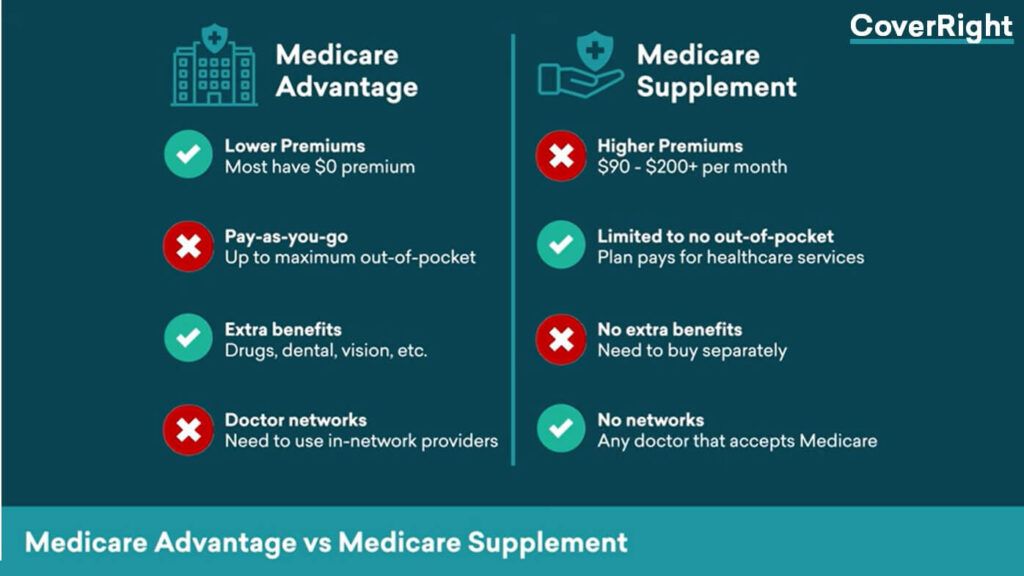
These plans are incredibly popular because they bundle everything together. They typically include your medical coverage, your Part D prescription drug coverage, and highly desired "extras" like dental, vision, and hearing benefits into one neat package. Many of these plans entice consumers with a $0 monthly premium.
However, that $0 premium carries heavy trade-offs. Advantage plans utilize restrictive provider networks (HMOs or PPOs). You must seek care from their approved list of doctors, and you often need formal permission (referrals or prior authorizations) to see a specialist or undergo a major procedure. Furthermore, they operate on a "pay-as-you-go" model; while the premium is low, you will pay out-of-pocket copays every time you interact with the healthcare system.
Medicare Supplement (Medigap)
Medicare Supplement plans do exactly what the name implies: they supplement Original Medicare. They do not replace it. Original Medicare remains your primary insurance, and the Medigap policy acts as a secondary payer.
When you use a Medigap plan, Original Medicare pays its approved share of your hospital or doctor bill. Then, the private Medigap plan automatically steps in to pay the remaining 20% coinsurance and deductibles that you would otherwise owe.
Medigap offers profound freedom and predictability. You are never restricted by a network; you can walk into any doctor's office or specialist in the United States that accepts Medicare. You rarely have to worry about copays or surprise bills. The trade-off? Medigap plans require a steep, upfront monthly premium. Additionally, they do not cover prescription drugs or dental/vision, forcing you to purchase standalone policies for those needs.
Choosing Your Path with Confidence
If you prioritize absolute freedom of choice in your doctors and want surgical predictability in your budget, Medigap is likely the superior choice. If you prefer low monthly premiums, bundled perks like dental coverage, and are comfortable navigating a network of providers, Medicare Advantage is a highly viable path.
Recent Posts