Home › Knowledge › Medicare Enrollment
What Are the Pros and Cons of Medigap Plan G?
Vedanth Bhartee
Writer · Reviewed by Richard ChanUpdated Jun 12, 2026
6 min read
Key Takeaways
Medigap Plan G covers 100% of the Medicare Part B excess charges and coinsurance, making out-of-pocket costs highly predictable.
Enrollees in Plan G are only responsible for paying the annual Medicare Part B deductible before comprehensive supplemental coverage begins.
Plan G does not include prescription drug coverage (Part D), meaning beneficiaries must purchase a standalone drug plan.
Wading through Medicare options can often feel exhausting. Today, we're cutting through the complexity to clarify exactly what Medicare Supplement (‘Medigap’) Plan G can offer you. The alphabet soup of Medicare plans is undeniably one of the most frustrating hurdles you'll face when securing your healthcare.
If You Want to Stop Reading Now and Call Us, We Can Make It Even Easier for You
If you prefer to research at your own pace, we invite you to explore the rest of today’s guide.
Let's Stir Up that Alphabet Soup of Choices
You'll find 10 standardized Medicare supplement insurance plans—commonly known as Medigap plans—available across most of the country. These plans are identified by the letters A, B, C, D, F, G, K, L, M, and N. The federal government rigidly standardizes these benefits, meaning a Plan G from one insurance company provides the exact same core coverage as a Plan G from a competitor.
Here is a quick snapshot of what these plans actually cover to protect your wallet:
- Plan A: Secures your basic benefits, covering Medicare Part A and Part B coinsurance, copayments, and hospice care coinsurance.
- Plan B: Delivers all the protections of Plan A, while also covering the costly Medicare Part A deductible.
- Plan C: Builds on Plan B by adding coverage for skilled nursing facility care, Part B excess charges, and critically, foreign travel emergency care.
- Plan D: Matches Plan A's benefits, plus steps in to handle the Part A deductible and skilled nursing facility coinsurance.
- Plan F: Mirrors Plan C’s extensive coverage, but takes it a step further by paying your Medicare Part B deductible.
- Plan G: Provides all the robust benefits of Plan F, with one exception: it does not cover the Medicare Part B deductible.
- Plan K: Takes a split approach, covering 50% of your Part A coinsurance, hospice care coinsurance, and the first three pints of blood. It also handles 50% of your Part B coinsurance and copayments.
- Plan L: Offers a higher level of cost-sharing, covering 75% of Part A coinsurance, hospice care, and the first three pints of blood, alongside 75% of Part B coinsurance and copayments.
- Plan M: Covers everything Plan D does, while adding a helpful 50% coverage of the Part A deductible.
- Plan N: Similar to Plan D, but it introduces minor copayments for certain Part B doctor visits and a copayment for emergency room trips that don't result in an admission.
Keep in mind that plan availability and pricing can fluctuate dramatically depending on your zip code. Most importantly, you must be actively enrolled in Original Medicare (Part A and Part B) to even be eligible to purchase a Medigap policy.
Why Do These Medicare Supplement Plan Options Exist?
Why would you need to pay for an entirely separate insurance policy?
The stark reality is that traditional Medicare (Parts A and B) was never designed to cover 100% of your medical bills. It leaves behind dangerous financial "gaps"—like 20% coinsurance charges—that can devastate your savings if you face a serious illness. Medigap policies exist precisely to plug those holes.
You cannot purchase these safety nets from Medicare directly; they are sold exclusively through private insurance companies.
What Plan G Offers You
Plan G is widely considered the gold standard for comprehensive coverage. It handles 100% of the costs that Medicare Part A covers, and takes care of all Part B out-of-pocket costs, except for the annual Part B deductible (which is $283 in 2026). Once you clear that single deductible, you won't pay a dime out-of-pocket for covered treatments and services.
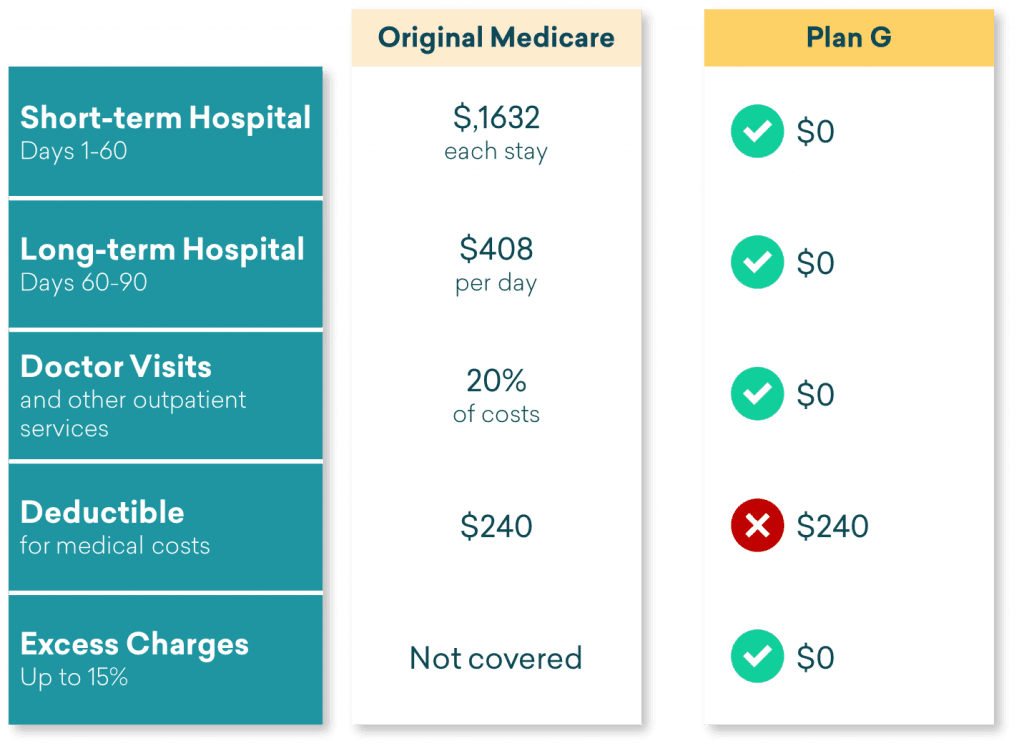
Crucially, Plan G also shields you from Part B "excess charges." If a doctor does not fully accept the Medicare-approved payment rate, they are legally allowed to charge you an additional 15% out of pocket. Plan G steps in and pays this 15% surcharge entirely.
What Does Plan G Typically Cost?
For the robust peace of mind it offers, the average Medigap Plan G premium in 2026 sits at $145 per month. Beyond that premium, your only other exposure is the annual Medicare Part B deductible, set at $283 in 2026.
Remember, because the government strictly standardizes the benefits, once you decide Plan G is right for you, your only job is to shop for the best possible price.
When Can You Enroll?
First things first: you must be enrolled in Original Medicare to purchase any Medigap plan. You can step into Original Medicare during several distinct windows:
- Initial Enrollment Period ? This is your primary 7-month window: the 3 months before your 65th birth month, your birth month, and the 3 months after.
- Medicare Annual Enrollment Period (AEP) – Running from October 15 to December 7 each year, this is when current beneficiaries can adjust their coverage. You cannot use AEP to sign up for Parts A or B for the very first time. Coverage chosen here activates on January 1 of the following year.
- Special Enrollment Period (SEP) ? Major life events—like losing employer coverage or moving to a new state—can trigger a 2-month window allowing you to adjust or enroll in coverage without penalty.
- Medicare General Enrollment Period (GEP) ? Spanning January 1 to March 31, this period is specifically for those who missed their initial chance to sign up for Part B. If you enroll here, coverage takes effect on July 1.
- Medicare Advantage Open Enrollment Period (MA-OEP) ? From January 1 to March 31, individuals already holding a Medicare Advantage plan can switch to a different Advantage plan or revert to Original Medicare (and pick up a stand-alone drug plan and Medigap policy).
What Are the Pros and Cons of Supplemental Plan G Coverage?
The Pros Include . . .
- It fundamentally covers the gaps in Original Medicare. Plan G mirrors all the services covered by Parts A and B, leaving you responsible solely for the Part B deductible ($283).
- It provides comprehensive safety for hospital stays (Part A) and completely eliminates out-of-pocket costs for preventive care and specialist visits once the Part B deductible is met.
- It replaces unpredictable, ruinous medical bills with a predictable monthly premium, effectively capping your healthcare financial risk.
- It completely wipes out the frustrating copays for Medicare-approved services.
- It grants you the ultimate freedom to see any doctor, specialist, or hospital nationwide that accepts Medicare. No restrictive networks.
The Cons Include . . .
- The upfront monthly premiums are undeniably higher than those of most Medicare Advantage plans, requiring room in your fixed monthly budget.
- It does not include prescription coverage; you are required to purchase a separate stand-alone Medicare Part D plan.
- It ignores dental, vision, and hearing benefits, meaning you'll need separate policies for those needs.
- If you apply outside your initial guaranteed issue window, insurance companies can subject you to medical underwriting. They could charge you exorbitant premiums or deny you coverage entirely based on your health history.
Want to Make the Best Choice for Medicare Plan G?
Related Posts