Home › Knowledge › Medicare Enrollment
What Type of Medicare Plan Is Best for You?
CJ Karrer
Writer · Reviewed by Richard ChanUpdated Jun 12, 2026
4 min read
Key Takeaways
The choice between Original Medicare (with a Medigap plan) and Medicare Advantage dictates your provider network and out-of-pocket costs.
Medicare Advantage plans bundle Part A, Part B, and usually Part D, often offering predictable copays and maximum out-of-pocket limits.
Standalone Prescription Drug Plans (Part D) are essential for those on Original Medicare to offset the high costs of retail prescription medications.
Determining which Medicare plan is best for your unique health and financial situation can feel incredibly daunting. And unfortunately, it seems like everyone has a quick answer to offer.
Perhaps a television commercial spokesperson insists that calling their toll-free number is the fastest way to enroll in an unbeatable plan. Or maybe your well-meaning friend suggests you avoid the hassle entirely by simply copying their coverage choices.
While it’s tempting to rely on these easy answers, healthcare is deeply personal, and the “easiest” solution is rarely the right one. Selecting your Medicare coverage is a significant milestone—comparable to buying a home, mapping out your retirement, or choosing a financial advisor. It requires careful thought and objective evaluation.
Taking your time is also a matter of financial protection. Rushing your enrollment can lead to permanent late penalties, locking yourself into a restrictive network, or discovering too late that your most critical medications and treatments aren’t covered.
| The Five-Minute Rule for Making Major Life Decisions – Would you purchase a home without taking time to carefully inspect it? – Did you select your college or career path in a matter of minutes? – If you needed major surgery, would you choose a specialist after a five-minute conversation? So why should securing your long-term health coverage be rushed? Choosing the right Medicare plan is a major life decision that deserves your full attention. |
By pausing to ask yourself the right questions, you can ensure that you’re making an informed choice designed for your specific lifestyle and health needs.
What Different Kinds of Plans Are There?
Navigating Medicare can sometimes feel like trying to translate a foreign alphabet. There is Original Medicare (Parts A and B). Then there is Medicare Part D, which specifically covers prescription drugs. On top of that, you have to weigh Medicare Advantage against Medicare Supplement (Medigap) plans. A brief phone call with an aggressive salesperson won’t provide the nuanced understanding you deserve.
Fortunately, you don’t have to decipher this alone. Comprehensive resources exist to give you a foundational education in what these terms actually mean and how they function together. Taking the time to visit educational hubs like a Medicare Learning Center can empower you with objective facts.
What Do Different Medicare Plans Cover . . . And What Don’t They Cover?
Understanding the fine print of coverage is critical. The good news is that you don’t have to memorize every single detail; you just need to know where to access reliable information when evaluating your options.
For a structured breakdown of benefits and exclusions, resources like the Medicare 101 course can serve as a comprehensive guide to navigating the system confidently.
What Are My Individual Care Needs and Which Plan Covers Them?
Choosing coverage requires a careful balancing act. You don’t want to drain your savings on premiums for benefits you’ll never use, but you also cannot afford a restrictive plan that leaves you stranded during a medical emergency.
Start by assessing your non-negotiables. On a fundamental level, is it vital that you keep your current doctors, minimize your hospital deductibles, and keep specialized co-pays predictable? Moving up the spectrum, do you rely on expensive, top-tier prescriptions that demand a robust drug plan? Finally, consider additional lifestyle benefits: are you looking for routine dental, vision, or chiropractic coverage? (Often, access to these extras points toward enrolling in a Medicare Advantage plan.)
Distinguish between what you absolutely need to manage your health and what you would merely like to have, provided the cost makes sense. Once you establish your priorities, you can begin matching them against the realities of available plans.
Keep in mind, you don’t have to execute this search completely on your own. Objective matching tools exist to do the heavy lifting for you. Answering a few straightforward questions is an excellent way to initiate the process.
How Would You Like to Pay for Your Medicare and Medicare Plan Coverage?
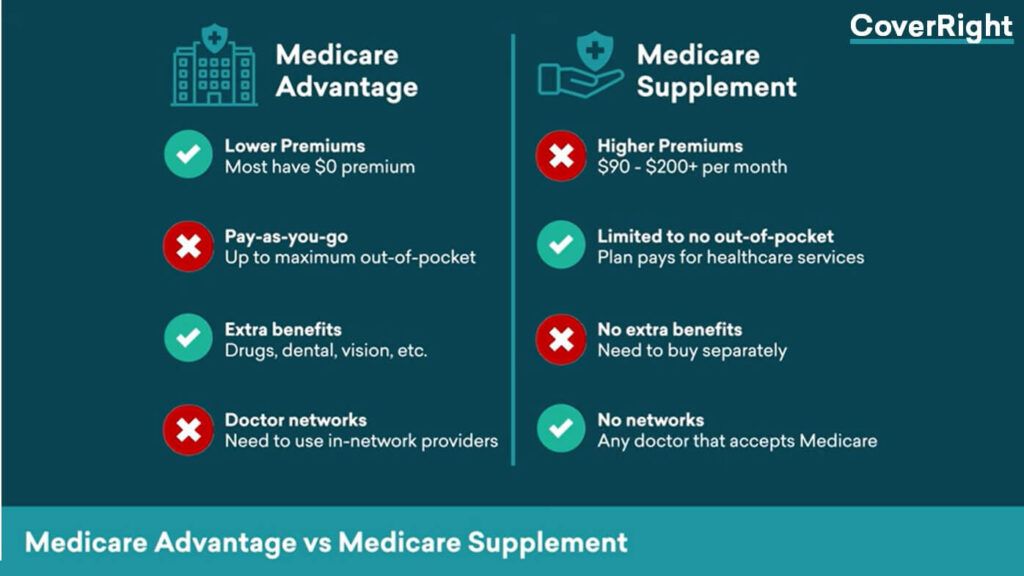
Cost is understandably a massive factor in your decision. While Part A is premium-free for most, Part B requires a standard monthly premium. Beyond that, your out-of-pocket costs will largely depend on whether you select Medicare Advantage or a Medicare Supplement (Medigap) plan. Medigap policies generally carry higher monthly premiums, but in exchange, they offer highly flexible, nationwide coverage with minimal unpredictable costs. On the other hand, Medicare Advantage plans often boast low (or even $0) monthly premiums, though they utilize HMO or PPO networks. This means you may face out-of-pocket copays as you receive care, require specialist referrals, and face strict limits on out-of-network coverage.
There is no universally correct answer here—only the solution that provides you with financial and emotional peace of mind. Speaking with an unbiased Medicare concierge can help eliminate the noise, ensuring you ask the right questions before making a commitment.
Put a Medicare Plan Finder to Work for You
Imagine having a powerful, interactive tool that filters out the irrelevant noise and directs you straight to the plans aligned with your medical realities.
——————