Home › Knowledge › Compare Medicare Plans by State
How Much Medicare Costs in 2026
Vedanth Bhartee
Writer · Reviewed by Richard ChanUpdated Jun 12, 2026
16 min read
Key Takeaways
The standard monthly premium for Medicare Part B is subject to annual adjustments and is based on a beneficiary's modified adjusted gross income.
Medicare Part A is premium-free for the majority of beneficiaries who have worked and paid Medicare taxes for at least 10 years.
Out-of-pocket costs, including the Part A and Part B deductibles, generally undergo annual modifications determined by the Centers for Medicare and Medicaid Services.
Key Takeaways
- Medicare premiums and deductibles saw modest bumps from 2026 to 2026, which gently ripples into out-of-pocket costs for many everyday beneficiaries.
- To gracefully avoid financial surprises, beneficiaries should make it an annual habit to deeply review their coverage to manage costs effectively.
- Fresh policies rolling out for 2026—like structural shifts to Medicare Part D’s cost-sharing approach—might actually put more money back in your pocket.
Medicare acts as a monumental federal safety net, offering health insurance to those celebrating their 65th birthday, along with younger Americans navigating specific disabilities.
However, while Medicare is designed to absorb a massive portion of your healthcare expenses, it does not cover every single bill.
So, how much does Medicare cost?
Looking ahead to 2026, Medicare costs break down like this: Part B premiums kick off at $202.90, many Medicare Advantage plans hover around an affordable $21, and a dedicated Part D prescription drug plan will typically cost you about $52 a month.
If you're seeking a stronger financial fortress, Medigap supplemental plans offer robust protection, with monthly premiums generally spanning from $95 to $320 depending on where you live and the specific plan you choose.
When you join the Medicare system, you step into a partnership. You are responsible for keeping up with your premiums as well as handling out-of-pocket realities like deductibles, copays, and coinsurance when you need medical care.
Because these costs have seen a slight upward tick from 2026, taking the time to review your Medicare strategy annually has never been more vital to protecting your savings.
Get clarity on Medicare costs in 2026—without the guesswork.
Medicare Costs in 2026: A Comparison with 2026
Note: This section carefully compares Medicare costs between 2026 and 2026, shining a light on shifting premiums, deductibles, and cost-sharing structures.
| Medicare Part | 2026 Premium | 2026 Premium | Difference |
| Part A (40+ quarters worked) | $0 | $0 | No change |
| Part A (30–39 quarters worked) | $278 | $285 | +$7 |
| Part A (fewer than 30 quarters) | $506 | $518 | +$12 |
| Part B (standard) | $202.90 | $202.90 | +$10.30 |
| Part D (average) | $48 | $52 | +$4 |
Deductibles and Cost-Sharing Adjustments
| Medicare Part | 2026 Deductible | 2026 Deductible | Difference |
| Part A inpatient hospital stay | $1,736 | $1,736 | +$44 |
| Part B deductible | $283 | $283 | +$17 |
| Part D maximum deductible | $545 | $590 | +$45 |
Implications of Medicare Cost Changes for Beneficiaries
The reality of rising premiums and deductibles in 2026 translates to higher out-of-pocket costs for most beneficiaries, hitting especially close to home for those fighting chronic illnesses or relying heavily on expensive daily medications.
- Budgeting: Families and retirees may need to carve out a bit more from their monthly budget to comfortably cover premiums and annual deductibles.
- Part D Changes: While the climb in deductibles and cost-sharing thresholds can be daunting if you require frequent prescriptions, there is a massive silver lining: catastrophic coverage plummets to 0% under the Part D redesign for 2026.
- Medicare Advantage: These plans continue to offer highly affordable premiums, but you must meticulously review your specific plan's details to avoid painful, unexpected copay hikes.
Visualizing Medicare Cost Trends
Note: Premium and deductible changes from 2026 to 2026.
| Medicare Part | 2026 | 2026 | Change (%) |
| Part A Premium (30–39 quarters) | $278 | $285 | +2.5% |
| Part A Deductible | $1,736 | $1,736 | +2.7% |
| Part B Premium (standard) | $202.90 | $202.90 | +5.9% |
| Part B Deductible | $283 | $283 | +7.1% |
| Part D Premium (average) | $48 | $52 | +8.3% |
Medicare Part A Costs
Medicare Part A serves as a crucial pillar of Original Medicare, swooping in to cover inpatient hospital stays, major surgeries, lab tests, short-term rehabilitation in skilled nursing facilities, essential home health care, and profoundly important hospice care.
Part A 2026 Premiums
There is incredible news for the vast majority of older Americans: roughly 99% of all Medicare beneficiaries qualify for premium-free Part A coverage.
This means you won't owe a single dime in monthly premiums to enjoy the deep hospital coverage that Part A provides.
To earn this premium-free status, either you or your spouse must have actively worked and paid into the Medicare tax system for a minimum of 10 years (or 40 quarters) over your lifetime.
| Medicare Taxes Paid | Monthly Premium |
| >40 quarters | $0 |
| >30 quarters | $278 |
| 0 – 29 quarters | $505 |
Part A Out-of-Pocket 2026 Costs
Even though the monthly premiums for Part A are nonexistent for most, you cannot ignore the out-of-pocket costs that will arise if you are hospitalized.
Inpatient Hospital Stays
If you rely solely on Original Medicare, an inpatient hospital stay will trigger specific deductibles and daily coinsurance costs that you must be prepared to pay.
| Part A Out of Pocket Cost | Cost |
| Inpatient hospital deductible | $1,736 |
| Daily coinsurance for 61st-90th Day | $419 |
| Daily coinsurance for lifetime reserve days | $838 |
It's important to remember that when you first enroll in Medicare, you are gifted 60 lifetime reserve days. Treat them like a precious safety net, because once they are used, they never renew.
Skilled Nursing Facilities (SNF)
In 2026, Medicare Part A provides reassuring coverage for short-term stays in an SNF. To qualify, you must have experienced an inpatient hospital stay lasting at least 3 days, and your doctor must officially declare that daily, specialized skilled care is absolutely necessary for your recovery.
If you find yourself needing this care in 2026, here is what your wallet will be responsible for under Part A:
- Days 1–20: A comforting $0 for each benefit period
- Days 21–100: A steep $209.50 coinsurance per day
- Days 101 and beyond: You assume 100% of the financial burden
Medicare Part B Costs in 2025
Medicare Part B is the other vital half of Original Medicare, rigorously stepping in to cover medically necessary outpatient care, routine doctor visits, and essential medical supplies.
This incredibly broad coverage net catches everything from life-saving ambulance rides and durable medical equipment to compassionate hospice support, home health care, and vital preventive screenings that keep you healthy.
Part B 2026 Premiums
For 2026, the standard monthly premium to secure your Medicare Part B coverage is set at $202.90.
Unlike Part A, absolutely everyone enrolled in Medicare Part B must consistently pay this monthly premium to keep their coverage active and robust.
Part B Premium Adjustment
If your reported income sits above a specific threshold, you will be required to pay a noticeably higher Part B premium than the standard national rate.
This frustrating surcharge is formally known as the Income Related Monthly Adjustment Amount, or IRMAA.
To calculate this, Medicare looks back at the modified adjusted gross income you reported to the IRS exactly two years ago. This is simply because it is the most recent, verified tax data that the IRS has handed over to Social Security.
For instance, the government will strictly use your finalized tax return from 2026 to dictate what your IRMAA surcharge will be in 2026.
Looking closely at 2026, if your reported income back in 2026 pushed past $106,000 as a single filer, or $212,000 filing jointly, your Part B premium will automatically be hit with an IRMAA surcharge, stripping away your access to the standard rate.
| Individual Filing | Joint Filing | Income-Related Monthly Adjustment Amount (IRMAA) | Monthly Premium (2026) |
| Less than or equal to $106,000 | Less than or equal to $212,000 | $0.00 | $202.90 |
| Greater than $106,000 and less than or equal to $133,000 | Greater than $212,000 and less than or equal to $266,000 | $72.90 | $283.90 |
| Greater than $133,000 and less than or equal to $167,000 | Greater than $266,000 and less than or equal to $334,000 | $189.30 | $374.30 |
| Greater than $167,000 and less than or equal to $200,000 | Greater than $334,000 and less than or equal to $400,000 | $306.00 | $491.00 |
| Greater than $200,000 and less than $500,000 | Greater than $400,000 and less than $750,000 | $395.60 | $580.60 |
| Greater than or equal to $500,000 | Greater than or equal to $750,000 | $436.20 | $621.20 |
Part B 2026 Deductible
The financial gateway you must cross each year—the annual deductible—is set at $283 in 2025 for every single Part B beneficiary.
You must clear this hurdle, paying the full amount directly out of your own pocket, before Medicare will finally unlock its vaults and start sharing the cost of your healthcare.
Part B 2026 Out-of-Pocket Costs
The math behind Medicare Part B cost-sharing is refreshingly straightforward. The moment you cross your annual Part B deductible threshold, your responsibility drops to just 20% of the Medicare-approved amount for critical services like doctor visits, outpatient therapy sessions, and vital durable medical equipment.
Medicare Part C Costs in 2026 (Medicare Advantage)
Medicare Part C—widely championed as Medicare Advantage—acts as a wildly popular "all-in-one" alternative. These robust plans are carefully crafted by private, federally approved health insurance titans to deliver your Medicare benefits in a neat, convenient package.
For many retirees, these plans represent a far more modern and comprehensive way to experience Medicare than the traditional Original Medicare route.
By strict federal law, Medicare Advantage plans are mandated to provide you with a level of coverage that is at least equal to what you would receive under Parts A and B of Original Medicare.
But Medicare Advantage rarely stops there. These plans famously bundle in Part D (Prescription Drug Coverage) and generously layer on lifestyle-enhancing perks that Original Medicare stubbornly ignores, such as comprehensive vision, hearing, and dental care.
Part C 2026 Premiums
If you decide to embrace the convenience of Medicare Advantage (Part C), it is critical to remember that you must relentlessly continue paying your foundational Medicare Part B premium of $202.90 every single month in 2026.
Depending entirely on the richness of the plan you select, you might also be required to pay an additional, separate monthly premium directly to the private insurance company managing your care.
The average estimated premium for a Medicare Advantage plan in 2026 sits at a highly approachable $21, but this is merely an average. Some incredibly efficient plans boast an eye-catching $0 premium, while luxury, feature-heavy options can comfortably soar past $200 a month.
Remarkably, going into 2026, an estimated 65% of all Medicare Advantage plans will flaunt a $0 premium. This means a vast majority of beneficiaries will enjoy expansive coverage without paying a dime above their standard Part B obligation.
Part C 2026 Out-of-Pocket Costs
When diving into a Medicare Advantage plan, your exact out-of-pocket realities—such as your deductibles, daily copays, and coinsurance percentages—are fiercely guarded and dictated by the specific private insurer, meaning they can wildly differ from one plan to the next.
- With most standard Medicare Advantage plans, you can expect to handle a modest copayment ranging from $0 to $25 when seeing your primary care physician, and roughly $25 to $55 when seeking out a specialist's expertise.
- If you are hospitalized, be prepared for daily copayments that typically hammer you for the first 5 to 7 days of your stay, though this heavily depends on the generosity of your chosen plan.
Maximum Out-of-pocket (MOOP)
One of the most profound benefits of Medicare Advantage plans is that they are legally forced to enforce a hard cap on your annual out-of-pocket spending, creating a massive financial firewall to protect your life savings.
As we look at 2026, these crucial out-of-pocket maximums are set at:
- $9,100 for all in-network medical services.
- A steeper $13,700 limit if you combine in-network and riskier out-of-network services.
This single feature radically differentiates Medicare Advantage from the terrifying reality of Original Medicare, which offers absolutely zero cap on your 20% share of catastrophic medical bills under Part B.
Medicare Part D Costs in 2026 (Prescription Drug Coverage)
Medicare Part D is your dedicated armor against the crippling costs of prescription drugs, sold exclusively by private insurance giants. If you proudly stick with Original Medicare, securing this vital protection requires purchasing a standalone Prescription Drug Plan (PDP).
Conversely, you effortlessly secure Part D coverage by enrolling in a Medicare Advantage (Part C) plan that already has prescription coverage intricately bundled in (frequently branded as "MA-PD" plans).
Part D 2026 Premiums
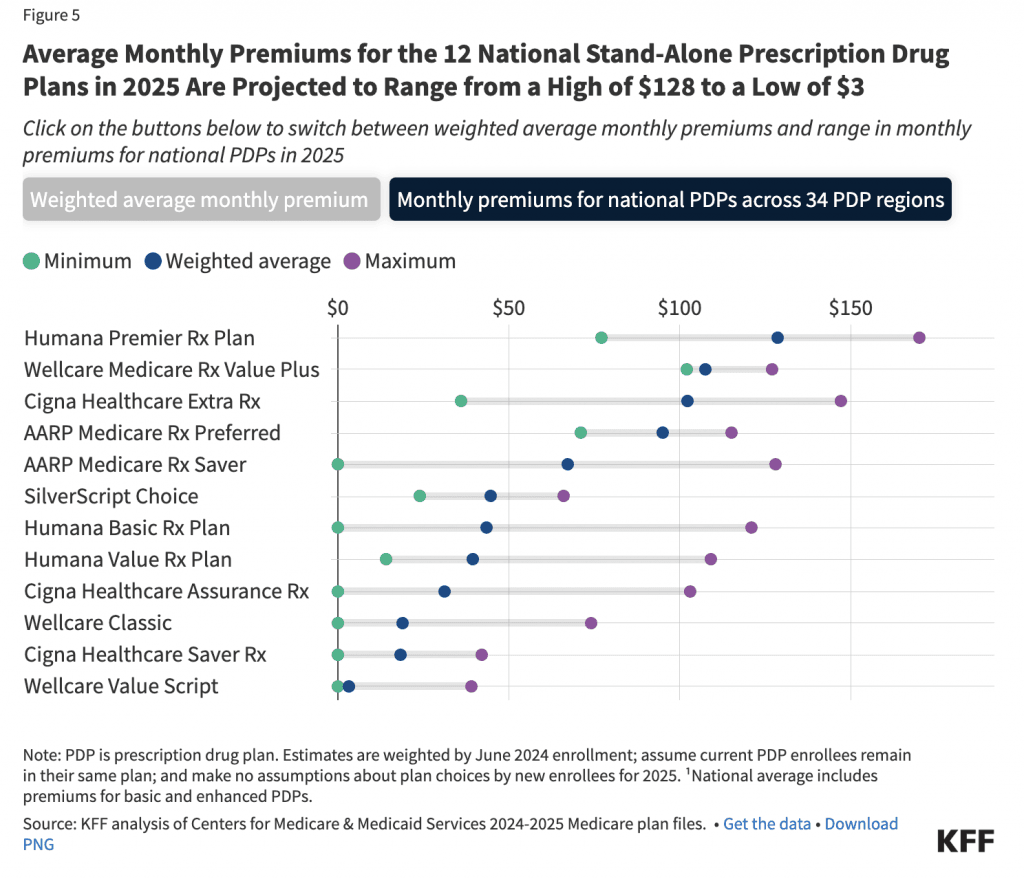
For those relying on Original Medicare and actively shopping for a standalone Prescription Drug Plan (PDP), be prepared for Part D premiums to fluctuate significantly from one insurer to the next.
The highly respected Kaiser Family Foundation powerfully projects that the national average enrollment-weighted monthly premium for a PDP in 2026 will land right at $52.
If you've opted for the bundled route with a Medicare Advantage plan that encompasses drug coverage (MA-PD), the financial sting of Part D is smoothly absorbed into your overarching Medicare Advantage premium, freeing you from the hassle of hunting down and paying for a separate Part D policy.
Part D 2026 Premium Adjustment
Much like the frustrating surcharge on Part B, high-income retirees (judged strictly by their 2026 income records) may find themselves slapped with steeper Medicare Part D premiums in 2026, entirely thanks to the Income-Related Monthly Adjustment Amount (Part D-IRMAA).
If you trigger the Part D IRMAA, Social Security will sternly notify you. It's crucial to understand that this extra penalty fee is paid directly to the government via Social Security, not to the private insurer handling your actual drug plan.
For 2026, the harsh reality of IRMAA adjustments breaks down as follows:
| Individual Filing | Joint Filing | Income-Related Monthly Adjustment Amount (IRMAA) |
| Less than or equal to $106,000 | Less than or equal to $212,000 | $0.00 |
| Greater than $106,000 and less than or equal to $133,000 | Greater than $212,000 and less than or equal to $266,000 | $13.80 |
| Greater than $133,000 and less than or equal to $167,000 | Greater than $266,000 and less than or equal to $334,000 | $35.50 |
| Greater than $167,000 and less than or equal to $200,000 | Greater than $334,000 and less than or equal to $400,000 | $57.30 |
| Greater than $200,000 and less than $500,000 | Greater than $400,000 and less than $750,000 | $78.80 |
| Greater than or equal to $500,000 | Greater than or equal to $750,000 | $86.40 |
Part D 2026 Deductible
While the deductibles tied to various Part D plans will bounce around based on your choice, the federal government firmly steps in to cap the absolute maximum deductible a plan can legally charge you in a calendar year.
For the 2026 coverage year, that government-mandated ceiling for your Part D deductible is locked at $590.
If the plan you choose features a deductible, brace yourself: you are entirely on the hook for 100% of your pharmacy bills until you cross that $590 finish line. Only then will your Part D plan awaken and begin shouldering the heavy burden of your medication costs.
Part D 2026 Out-of-Pocket Costs
Navigating Part D is essentially a journey through four distinct coverage phases, and your out-of-pocket copays and coinsurance will radically shift depending on which phase you currently occupy.
Insurance companies cleverly organize their massive lists of covered drugs (formularies) into complex cost-sharing "tiers." The specific tier your life-saving drug lands on will ultimately dictate exactly how agonizing your copayment or coinsurance will be at the pharmacy counter.
A typical plan will furiously sort medications into 3 or 4 rigidly structured tiers, with lower tiers offering immense relief and higher tiers dealing heavy financial blows. Here is a standard breakdown:
- Tier 1: The cheapest oasis: Generic Drugs
- Tier 2: The middle ground: Preferred Brand Name Drugs
- Tier 3: The painful climb: Non-preferred Brand Name Drugs
- Tier 4: The financial breaking point: Exorbitant "specialty" drugs
How much is Medicare Supplement in 2026 (Medigap)?
Sold by major private insurance players, Medicare Supplement (or "Medigap") plans act as an impenetrable fortress, fiercely defending you from the terrifying out-of-pocket costs (the dangerous "gaps") that Original Medicare lazily leaves behind—most notably, the agonizing 20% coinsurance under Part B.
You must choose your path wisely: federal law strictly prohibits you from holding a Medigap policy if you are already enrolled in a Medicare Advantage plan.
Much like the Wild West of Medicare Advantage and Part D, the exact price tag for a Medigap policy in 2026 is entirely at the mercy of the private insurer, heavily swinging based on:
- The specific letter plan you bravely choose (there are 10 heavily standardized options available nationwide, with Plan F, G, and N leading the pack).
- The specific zip code where you rest your head.
- Intensely personal factors such as your precise age, your gender, and the current reality of your health.
Estimated Monthly Premiums (2026):
- Plan G: The undisputed king of comprehensive coverage, commanding a national average premium of $170–$250, wildly fluctuating based on your chosen insurer and geographic home.
- Plan N: The budget-conscious warrior, offering comforting premiums that normally land between $120–$200, but constantly reminding you of its presence with pesky copayments for routine doctor visits or unexpected trips to the emergency room.
To prevent buyer's remorse, beneficiaries are passionately encouraged to fiercely compare premiums against plan benefits to confidently lock in a policy that perfectly respects both their physical vulnerability and their strict retirement budget.
Premiums for life-changing Medicare Supplement plans (specifically the powerhouses Plan F, G, and N) going into 2026 generally hover between $95 and an intimidating $320 per month. Prepare for these costs to radically diverge based on your chosen plan type, the specific insurance company, your geographic location, and highly personal variables like your age and medical history.
- Plan G: Earning the crown as the most aggressively sought-after Medigap plan, Plan G commands an average monthly premium of roughly $175 on a national scale, with regional costs violently swinging from $150 all the way to $250, dictated entirely by where you live and the insurer you trust.
- Plan N: An incredible option for the healthy and budget-minded, Plan N tempts with noticeably lighter premiums, confidently landing in the $130 to $210 range. Just remember that it balances those savings by hitting you with small copayments every time you see a doctor or rush to the emergency room.
Adding to the complexity, your Medigap premium is heavily manipulated by the specific pricing mechanism the insurance company uses to calculate your risk:
- Community-rated: A beautiful equalizer where everyone in the community is charged the exact same premium, completely ignoring the reality of their age.
- Issue-age-rated: A snapshot in time where your premium is firmly rooted in the exact age you were the moment you signed the contract.
- Attained-age-rated: The most brutal approach, where your premium mercilessly creeps higher with every single birthday you celebrate.
To survive this maze, beneficiaries must ruthlessly compare their plan options and the terrifying reality of pricing structures to successfully discover the precise coverage that respects both their fragile health and their rigid retirement budget.
Review Coverage Annually
Because premiums and devastating out-of-pocket maximums refuse to stay still and blindly increase every single year, it is absolutely paramount that you meticulously review your coverage annually. Always take the time to deeply explore powerful options like Medigap to forcefully suppress any terrifying unexpected expenses. Staying fiercely educated on these relentless changes ensures you step into each new calendar year utterly prepared and heavily armed to dominate your Medicare journey.
For deeply compassionate, tailored assistance and rock-solid support, strongly consider reaching out to an empathetic licensed advisor—especially when the time comes to make the critical decision regarding your supplemental coverage.
Sources
- Medicare.: Medicare Costs in 2026. Published 2026. Last Accessed January 2026.
- CMS.: 2026 Part D Redesign Fact Sheet. Published 2026. Last Accessed January 2026.
- NCOA.: Medicare Part D Cost-Sharing Chart. Published 2026. Last Accessed January 2026.
- Medicare.: Avoid Late Enrollment Penalties. Last Accessed January 2026.
- KFF: Medicare Part D in 2026: A First Look at Prescription Drug Plan Availability, Premiums, and Cost Sharing. Published 2026. Last Accessed January 2026.