Home › Knowledge › Medicare Advantage
Best Medicare Advantage Plans in Texas (November 2026)
Vedanth Bhartee
Writer · Reviewed by Richard ChanUpdated Jun 12, 2026
12 min read
Key Takeaways
Texas Medicare Advantage plans provide an all-in-one alternative to Original Medicare, frequently including Part D prescription coverage and annual out-of-pocket maximum limits.
Insurers like KelseyCare Advantage and Humana offer Texas-specific plans with added benefits such as routine vision, hearing aids, and over-the-counter allowances.
Beneficiaries must reside in the plan's specific Texas service area to enroll and must continue paying their standard Part B premium to Medicare.
Navigating healthcare options can feel overwhelming, especially when trying to balance your medical needs with a strict budget. Medicare Advantage (also known as Medicare Part C) plans cover all the essential services that Original Medicare (Part A and Part B) provides, while often folding in prescription drug coverage and helpful extra benefits. Because of this comprehensive approach, Medicare Advantage plans have become an increasingly popular choice for those seeking peace of mind without breaking the bank.
If you call Texas home, you have a wealth of options when evaluating Medicare Advantage plans. However, with so many massive insurance companies competing for your attention, cutting through the noise to find the specific providers and plans that genuinely align with your life and health needs is crucial.
Texas boasts a deeply diverse market of Medicare Advantage plans from household-name insurers. To help guide you through this critical decision, we’ll cut straight to the facts—comparing drug coverage, real member experiences, and the availability of plans that respect your wallet. We'll outline hard data for select providers, including those all-important monthly premiums and potential out-of-pocket costs, so you can make an empowered choice.
Compare Medicare Advantage Providers in Texas
Before diving into the numbers for Texas' major Medicare Advantage providers, it's vital to understand the yardsticks used to measure a plan's true value:
CMS Star Rating: Published annually by the Centers for Medicare & Medicaid Services (CMS), this rating objectively measures the quality of health and drug services members receive. Ranging from 1 (poor) to 5 (excellent) stars, this overall score weighs up to 40 distinct performance metrics and serves as a highly reliable benchmark when comparing plans.
Monthly Premium: This is the fixed dollar amount you pay out of your own pocket to a provider each month to keep your health coverage active.
In-Network Max Out-of-Pocket Amount: A critical financial safety net, this is the absolute maximum you will be required to pay for covered, in-network services during a specific coverage period (typically one calendar year).
Note: The statistics provided in the charts below are calculated using the most accurate plan data specific to the state of Texas.
National Providers
| Provider Name | Average CMS Star Rating | Median Monthly Premium | Median In-Network Max Out-of-Pocket $ |
| UnitedHealthcare | 3.9★ | $0.00 | $6,400 |
| Humana | 4.0★ | $0.00 | $6,900 |
| Aetna | 3.5★ | $0.00 | $6,000 |
| Cigna Healthcare | 3.5★ | $0.00 | $5,700 |
| Wellcare | 2.8★ | $0.00 | $5,900 |
Regional Providers
| Provider Name | Average CMS Star Rating | Median Monthly Premium | Median In-Network Max Out-of-Pocket $ |
| KelseyCare Advantage | 5.0★ | $0.00 | $3,850 |
| Devoted Health | 4.5★ | $0.00 | $3,900 |
| Prominence Health Plan | 4.0★ | $0.00 | $3,775 |
| Baylor Scott & White | 3.9★ | $28.40 | $5,000 |
Keep in mind that while smaller, regional providers may boast top-tier CMS ratings, their network of approved physicians and hospitals is typically much narrower than those of the massive national providers.
Top-Rated Medicare Advantage Providers in Texas
Humana
Humana stands out as a colossal entity in the U.S. health insurance sector, delivering a vast array of healthcare products, with a heavy emphasis on Medicare.
They currently service 1.8 million members statewide in Texas, focused strongly across two massive partner communities (Houston and San Antonio). Looking at national market share, they are the second largest provider of Medicare Advantage plans in the United States, commanding a 17.8% slice of the market.
KelseyCare Advantage
KelseyCare holds a unique honor: they are the provider of the only CMS 5-star rated Medicare Advantage plan in Texas. They have impressively maintained Medicare’s highest star rating every single year since 2017. They also boast one of the largest provider networks for any regional provider in Texas, ensuring their members have access to more than 7,500 doctors.
Today, KelseyCare Advantage serves over 50,000 members, providing robust Medicare service across 13 counties throughout Texas.
Cigna Healthcare
Cigna Healthcare operates as a formidable global health services organization, providing a massive spectrum of health insurance products. For 2026, Cigna will offer their competitive Medicare Advantage plans to eligible members across 29 states. In addition, they will offer three standalone prescription drug plans (PDPs) available to eligible members in all 50 states (as well as Washington D.C. and Puerto Rico).
United Healthcare
UnitedHealthcare is a ubiquitous national provider of health insurance. They currently lead the fiercely competitive Medicare Advantage market nationally, boasting a 28.5% national market share and serving over 9 million enrollees. Locally, they are an absolute titan, securing the spot as the Medicare Advantage market share leader in Texas with a commanding 50% hold.
They also hold the title for the fastest-growing MA provider, expanding by 12.7% year-over-year from 2022 to 2026.
Aetna
Operating as a major subsidiary of the CVS Health Corporation, Aetna is another formidable national health insurance provider.
As of March 2026, Aetna cemented its status as the third-largest provider of Medicare plans overall (with a 10.6% market share) and emerged as the largest provider of standalone Medicare prescription drug plans (capturing 27.2% of that specific market).
Devoted Health
Devoted Health positions itself as an innovative, all-in-one healthcare company tailored exclusively for Medicare beneficiaries. They go beyond merely delivering health insurance—they actively strive to provide seamless, high-quality medical care coordination.
Despite being leaner than the national giants, Devoted Health has meticulously cultivated a very strong, reliable presence across Texas.
Prominence Health Plan
Prominence Health Plan’s journey began in 1993 as an HMO in Reno, Nevada. Since then, they have strategically expanded to provide high-quality Medicare Advantage plans to eligible residents across Nevada, Florida, and importantly, Texas.
The company operates robust locations across the state, including Amarillo, Laredo, McAllen, and Denison.
Baylor Scott & White
Baylor Scott & White holds the impressive title of the largest not-for-profit health system in Texas. They offer their highly regarded “BSW SeniorCare Advantage” plans to Medicare-eligible residents in North and Central Texas, and the “Covenant Health Advantage” specifically for the Medicare-eligible population of West Texas.
BSW’s formidable network provides access to 4,900 primary care physicians and an astounding 24,500 specialists, while the Covenant network provides access to 385 primary care physicians and 1,130 specialists.
Wellcare
Wellcare is a sprawling healthcare enterprise offering insurance solutions to Americans from coast to coast. Medicare Advantage remains one of Wellcare’s flagship products, earning them a 4.3% national market share.
By 2026, they also ranked as the second-largest provider of prescription drug plans (PDPs) with a 19.9% market share. Like their massive competitors, Wellcare maintains a formidable presence in Texas, backed by deep, statewide connections to hospitals, services, and physicians.
How to Choose the Best Medicare Advantage Plan
Selecting the right Medicare Advantage plan—one that truly addresses your specific health realities and financial constraints—is a deeply personal and critical decision. Let’s break down the necessary steps to make this complex process as clear as possible.
From honestly assessing your physical needs to diving into the fine print of plan documents, our objective is to arm you with the factual knowledge needed to confidently navigate your options.
- Assess Your Healthcare Needs: Take a hard look at your medical realities. Tally up your prescription medications, estimate your annual doctor visits, and factor in any specialized treatments or therapies you require.
- Review Plan Options: Investigate the Medicare Advantage plans available in your specific zip code. Compare the depth of coverage, the out-of-pocket costs, and the extra benefits, prioritizing plans offered by stable, reputable insurers.
- Check Network Providers: Never assume your doctors are covered. Verify that your preferred primary care physicians, specialists, and local hospitals are firmly inside the plan's network to avoid massive out-of-network bills.
- Evaluate Drug Coverage: If you rely on daily medications, you must scrutinize each plan's formulary (their list of covered drugs). Pay close attention to the assigned tiers, which dictate your copayments, coinsurance, and deductibles.
- Consider Additional Benefits: Medicare Advantage plans frequently bundle in extras that Original Medicare ignores, such as routine dental, vision care, or gym memberships. Weigh these perks based on what you will actually use.
- Examine Cost Structures: Do the math. Compare the monthly premiums, the annual deductibles, and the per-visit copayments. Ensure these numbers align with a realistic budget based on your expected medical usage.
- Check Star Ratings: Always consult Medicare's official Star Ratings. Plans boasting higher ratings have objectively proven to deliver better care, superior customer service, and more reliable health outcomes.
- Understand Plan Rules and Restrictions: Read the fine print. Know exactly what the plan demands from you, such as prior authorizations for procedures or mandatory referrals before seeing a specialist.
- Review Out-of-Pocket Maximums: Identify the absolute maximum you could be forced to pay in a worst-case scenario. This cap is your financial shield against catastrophic medical debt.
- Get Personalized Assistance: If you're feeling stuck, reach out to CoverRight for objective, personalized support. We're here to cut through the confusion and guide you smoothly through enrollment.
Because every individual's health and financial situation is completely unique, the "best" Medicare Advantage plan is entirely subjective. If you are grappling with specific questions about your personal circumstances, we strongly suggest scheduling a free consultation with a licensed insurance agent.
Furthermore, if you are actively scrutinizing your prescription drug expenses, we highly advise discussing generic alternatives with your doctor. When available, the generic version of a drug will dramatically reduce your costs compared to the brand-name equivalent.

What Medicare Advantage Plans Cover
Offered exclusively by Medicare-approved private insurance corporations, Medicare Advantage plans (or Medicare Part C) provide an alternative route for receiving your Medicare benefits.
By law, these plans must deliver all the basic coverage provided by Original Medicare (Part A and Part B), while frequently throwing in additional perks. Here is a factual summary of what you can expect a Medicare Advantage plan to cover:
- Hospital Coverage (Part A): This crucial component covers your inpatient hospital stays, necessary care in a skilled nursing facility, hospice care, and specific forms of home health care.
- Medical Coverage (Part B): This covers the day-to-day medical necessities: outpatient care, standard doctor visits, vital preventive services, and additional home health care.
- Prescription Drug Coverage (Part D): A major selling point is that many Medicare Advantage plans integrate prescription drug coverage directly into the plan. If yours does not, you generally have the option to purchase a standalone Medicare Part D plan.
- Additional Benefits: Depending entirely on the specific plan you select, Medicare Advantage can offer valuable benefits that Original Medicare ignores. This frequently includes routine dental work, vision exams, hearing aids, and specialized fitness or wellness programs.
- Out-of-Pocket Maximums: Unlike Original Medicare, these plans are legally required to feature an annual cap on your out-of-pocket medical expenses, offering vital financial protection against catastrophic illness or injury.
It is imperative to recognize that exact coverage details fluctuate wildly between different Medicare Advantage plans. You must meticulously review official plan documents, specifically the Summary of Benefits, to ensure it meets your real-world needs.
Finally, never forget: enrolling in a Medicare Advantage plan does not absolve you from paying your standard Medicare Part B premium, which you must continue to pay alongside any premium charged by your Advantage plan.
When to Enroll for Medicare Advantage Plans in Texas
Your Initial Enrollment Period triggers when you first become eligible for Medicare, which is generally around your 65th birthday. Later, the Annual Enrollment Period (AEP) opens every year from October 15 to December 7, granting you the crucial window to switch, drop, or formally add a Medicare Advantage plan.
Additionally, the Medicare Advantage Open Enrollment Period, running from January 1 to March 31, allows current enrollees one chance to change their Advantage plan or revert entirely back to Original Medicare.
Life happens, and Special Enrollment Periods can be triggered by major events—such as moving out of your plan's service area, suddenly losing your employer-provided coverage, or qualifying for Medicaid. Staying acutely aware of these rigid deadlines is the only way to maintain control over your Medicare Advantage coverage in Texas.
??Medicare Advantage vs. Medigap
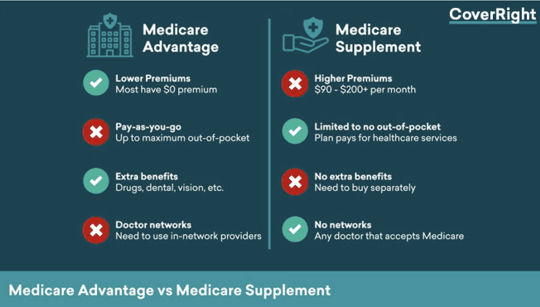
The choice between a Medicare Advantage (Part C) plan and a Medigap (Medicare Supplement) policy is a fundamental fork in the road for your healthcare. Medicare Advantage packages Part A and Part B together, heavily leaning into extras like built-in prescription drug coverage.
These unified plans are highly prized for their affordability and simple, all-in-one administration, even though they demand you stay within a defined network of doctors and hospitals.
Unsurprisingly, Medicare Advantage is exceptionally popular in Texas. As of May 2026, nearly 52% of Texas residents who are eligible for Medicare were enrolled in private Medicare Advantage plans. This figure confidently outpaces the 2026 national average of 51%.
Conversely, Medigap policies function as a financial backstop to Original Medicare, explicitly designed to pay the out-of-pocket costs (like deductibles and 20% coinsurance) that Original Medicare leaves behind. While Medigap grants you the ultimate freedom to see any doctor who accepts Medicare nationwide, it commands significantly higher monthly premiums.
Here is an objective breakdown of how the two stack up:
| Medigap (Medicare Supplement) | Medicare Advantage (Part C) | |
| Coverage | – Comprehensive coverage of out-of-pocket costs. | – Bundled coverage, often includes prescription drugs and extras. |
| – Greater flexibility in choosing healthcare providers. | – Limited to network providers; may require referrals. | |
| Costs | – Higher premiums but lower out-of-pocket costs. | – Lower premiums, but potential for higher out-of-pocket costs. |
| Prescription Drugs | – Doesn’t typically include prescription drug coverage. | – Often includes prescription drug coverage. |
| Network Restrictions | – No network restrictions; can see any doctor accepting Medicare. | – Limited to network providers; may require referrals. |
| Administration | – Simplifies administrative processes with a single plan. | – Requires managing multiple aspects (Part A, B, and sometimes D). |
| Flexibility | – Freedom to use healthcare services nationwide. | – May be limited to specific geographic regions or networks. |
| Additional Benefits | – Focuses solely on medical costs; no additional benefits. | – May include extra benefits like dental, vision, and wellness programs. |
| Decision Criteria | – Suited for those who prioritize flexibility and are willing to pay higher premiums. | – Attractive for those seeking bundled coverage with potentially lower costs. |
Ultimately, your decision comes down to what lets you sleep at night: Medicare Advantage offers cost-effective, bundled convenience with strict network rules, while Medigap provides total geographic and provider freedom for a predictably higher monthly price tag.
All Medicare Advantage Providers in Texas for 2026
- Aetna Medicare
- Alignment Health Plan
- Amerigroup (called Wellpoint in 2026)
- Baylor Scott & White Health Plan
- Blue Cross Blue Shield of New Mexico.
- Blue Cross Blue Shield of Oklahoma
- Blue Cross and Blue Shield of Texas
- Care N’ Care Insurance Company
- CHRISTUS Health Advantage
- Cigna
- Clover Health
- Community First Health Plans
- Devoted Health
- Humana
- KelseyCare Advantage
- Memorial Hermann Health Plan
- Molina Healthcare of Texas
- Prominence Health Plan
- SCAN Health Plan
- UnitedHealthcare
- Verda Health Plan of Texas
- Wellcare
- Wellcare by Allwell