Home › Knowledge › Medicare Supplement (Medigap)
The Worst Medicare Supplement Plans in 2026
Vedanth Bhartee
Writer · Reviewed by Richard ChanUpdated Jun 12, 2026
11 min read
Key Takeaways
Medicare Supplement (Medigap) plans standardize benefits by letter type, meaning a Plan G offers the exact same coverage regardless of which insurance carrier sells it.
Choosing a poorly rated plan often relates to selecting carriers with histories of aggressive premium increases or poor financial stability rather than differences in core medical benefits.
Some Medigap plans, such as Plan F and Plan C, are no longer available to new Medicare enrollees, and high-deductible versions may result in larger out-of-pocket costs before coverage begins.
Medicare Supplement, or Medigap, is a type of private insurance designed to plug the financial holes that Original Medicare (Part A and Part B) leaves behind — things like deductibles, copayments, and coinsurance that can quietly drain your savings. Private insurers offer these plans specifically to shield beneficiaries from those unpredictable out-of-pocket costs. So if you're approaching Medicare eligibility, it's worth pausing to seriously evaluate whether a Supplement plan belongs in your coverage strategy.
That said, Medicare Supplement plans aren't a universal win. Some plans look reasonable on paper but fall short in practice — either because of limited benefits, sky-high premiums, or the financial track record of the insurer selling them. In this article, we'll walk through the characteristics that make certain Medigap plans worth avoiding.
Currently, 10 federally standardized Medigap plans are available in most states: Plans A, B, C, D, F, G, K, L, M, and N. Each offers a distinct level of coverage. Plans E, H, I, and J are no longer sold, though existing holders retain their benefits. Plans F and C are off the table for anyone who became eligible for Medicare after January 1, 2020 — though those who were eligible before that date can still purchase them.
Medicare Supplement Plan Comparison Chart
| Benefit | Plan A | Plan B | Plan C | Plan D | Plan F* | Plan G* | Plan K | Plan L | Plan M | Plan N |
| Part A coinsurance and hospital costs up to 365 days after Medicare benefits are used | Y | Y | Y | Y | Y | Y | 50% | 75% | Y | Y |
| Part B coinsurance or copayment | Y | Y | Y | Y | Y | Y | 50% | 75% | Y | Y*** |
| Blood (first 3 pints) | Y | Y | Y | Y | Y | Y | 50% | 75% | Y | Y |
| Part A hospice care coinsurance or copayment | Y | Y | Y | Y | Y | Y | 50% | 75% | Y | Y |
| Skilled nursing facility care coinsurance | ? | ? | Y | Y | Y | Y | 50% | 75% | Y | Y |
| Part A deductible | ? | Y | Y | Y | Y | Y | 50% | 75% | 50% | Y |
| Part B deductible | ? | ? | Y | ? | Y | ? | ? | ? | ? | ? |
| Part B excess charge | ? | ? | ? | ? | Y | Y | ? | ? | ? | ? |
| Foreign travel exchange (up to plan limits) | ? | ? | 80% | 80% | 80% | 80% | ? | ? | 80% | 80% |
| Out-of-pocket limit** | N/A | N/A | N/A | N/A | N/A | N/A | $7,060 in 2026 | $3,530 in 2026 | N/A | N/A |
Notes: Y = Yes, ? = Not Covered
* Plans F and G also offer a high-deductible plan in some states. With this option, you must pay for Medicare-covered costs (coinsurance, copayments, and deductibles) up to the deductible amount of $2,800 in 2026 before your policy pays anything. (Plans C and F aren't available to newly eligible people for Medicare on or after January 1, 2020.)
** For Plans K and L, after you meet your out-of-pocket yearly limit and your yearly Part B deductible, the Medigap plan pays 100% of covered services for the rest of the calendar year.*** Plan N pays 100% of the Part B coinsurance, except for a copayment of up to $20 for some office visits and up to a $50 copayment for emergency room visits that don't result in inpatient admission.
With so many plan types and coverage levels in the mix, how do you actually identify the worst Medicare Supplement plans? The answer hinges on a few key factors — premium costs, coverage gaps, and the financial health of the carrier behind the policy.
High Monthly Premiums
Here's a reality that catches many new enrollees off guard: a Medicare Supplement plan isn't free. On top of your standard Medicare Part B premium — which you pay to Social Security — you'll owe an additional monthly premium to your private insurer. For beneficiaries on fixed incomes, that added cost can be a genuine financial strain. And what makes it especially frustrating is that your personal characteristics — age, gender, location, tobacco use — all factor into how much you'll pay.
Here's the critical thing to understand about Medigap standardization: if you purchase a 'Plan G' from Company A, it is exactly the same coverage as a 'Plan G' from Company B. Once you've settled on the right plan type for your needs, you're really only comparison-shopping on two dimensions:
- Price (Monthly Premium)
- Reputation of the Carrier
That's what makes high-premium plans so damaging — you're paying more money for the identical coverage your neighbor might be getting at a lower monthly cost simply because they shopped around.
Stop overpaying for Medigap. Start making Medicare work for you.
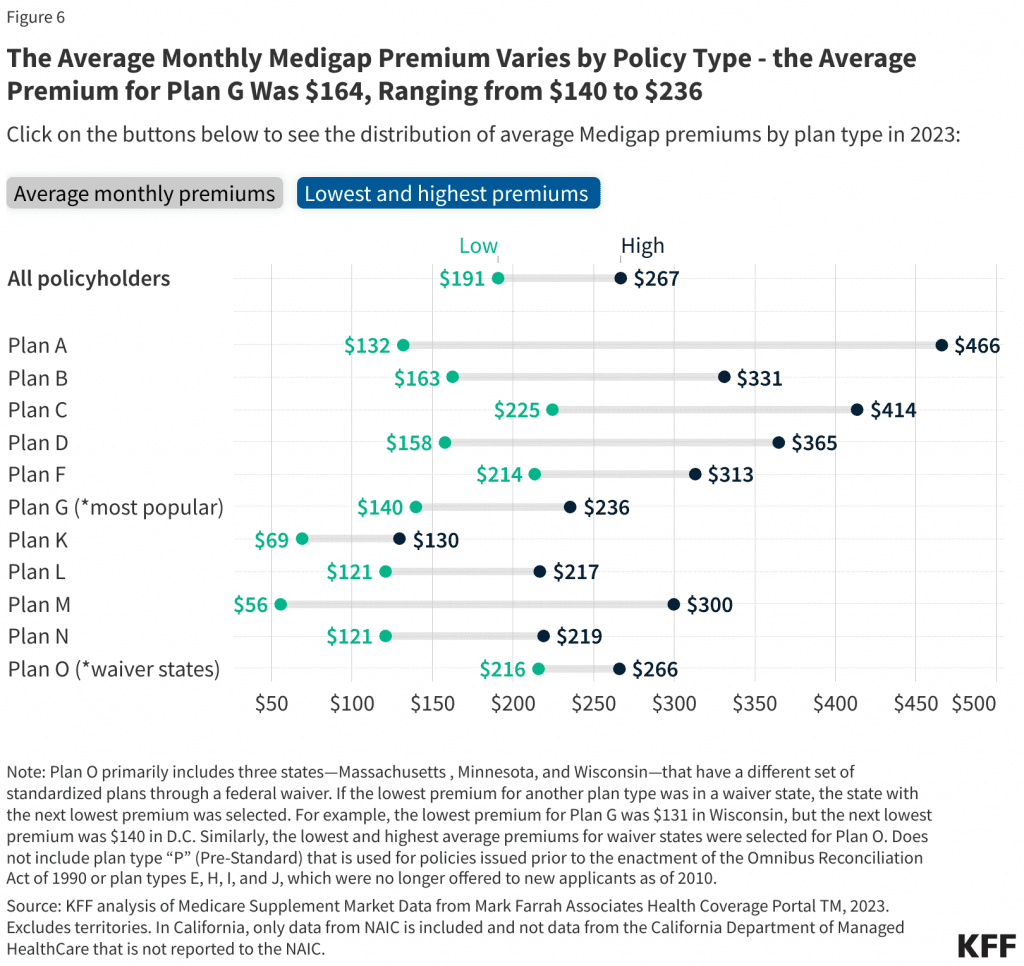
On average, the monthly premium for Plan G is $164, though premiums can range from $140 to $236 depending on factors like age, location, and the insurance provider. The chart below illustrates the range of premiums across different Medigap policy types, providing a snapshot of average costs for beneficiaries.
Regardless of which insurer you ultimately choose, your rates will climb every year — so why wouldn't you start from the lowest possible base?
In most cases, premiums increase by a few percent annually. These rate hikes stem from two distinct forces:
- insurance companies calculate your rate based on your age when you enroll — younger entrants pay less, and those costs rise steadily as you age
- insurers typically layer on an additional 2% to 4% increase for general medical cost inflation
Average Medigap Premium Increase Chart
| 65 Year Old | 80 Year Old | % Increase |
| $131.30 | $208.79 | 59.02% |
| $129.86 | $190.84 | 46.96% |
| $134.81 | $217.58 | 61.40% |
| $166.08 | $289.13 | 74.09% |
| $145.75 | $217.82 | 49.45% |
Lack of Hospital Deductible Coverage
If there's one coverage gap that can hit beneficiaries the hardest, it's the hospital deductible. Hospital stays are among the most financially devastating health events a person can face, and enrolling in a Medigap plan that leaves you exposed to that deductible is a risk that's easy to underestimate — until you need it.
Medigap Plan A is one of the most prominent examples of this vulnerability. It does not cover the Medicare hospital deductible of $1,736 in 2026 — a deductible that resets with every new "benefit period." In plain terms: if you're hospitalized multiple times in a year, you could face that cost multiple times over, with no plan coverage to absorb the blow.
| Benefit | 65-74 years old | 75-84 years old | 85+ years old |
| Mean length of stay, days | 5.3 | 5.6 | 5.6 |
| Mean hospital costs | $12,400 | $11,400 | $9,400 |
Generally, it is not worthwhile purchasing Plan A and B as these basic plans have limited members. You will often find that the price of these "basic" plans may carry a higher monthly premium than plans with more comprehensive coverage — simply because so few people are enrolling in them that the risk pool shrinks and costs rise.
Less than Full Payment for Covered Services
Plans K and L have a built-in appeal: they're the only two Medigap options that include an annual out-of-pocket spending cap. But that headline feature comes with a meaningful trade-off that many enrollees don't fully appreciate until they're facing a medical bill. Plan K and Plan L do not pay 100% of the services they cover — they pay a fraction.
Specifically, these plans will 1) only cover up to 50% of both your Part A deductible and Part B coinsurance or copayment, and 2) will not cover Medicare Part B excess charges at all. For most people, that partial-payment structure ultimately outweighs any comfort provided by the out-of-pocket limit.
Plan K is only a sensible fit for people who are newly aging into Medicare, are accustomed to employer-sponsored coverage with cost-sharing, carry their own out-of-pocket expenses, and live in states where excess charges are prohibited. Plan L covers a somewhat higher share (~75%) of certain Medigap benefits like Part B coinsurance and copayment, but it's still most appropriate only for those in excess-charge-free states.
And it's worth being very direct about Part B excess charges: while they don't apply in every situation, if you live in a state that permits them and you see a non-participating Medicare provider, that provider can legally charge you up to 15% above Medicare's approved amount. That's a real financial exposure that Plans K and L leave entirely uncovered.
Additionally, when you use non-participating providers:
- You may be expected to pay the whole charge upfront and wait until Medicare pays your provider to be reimbursed.
- Your provider is supposed to submit your claim to Medicare and isn't allowed to charge you for doing so.
It's generally best to avoid Plan K or L and select a Medigap plan that pays in full for covered services.
Financial Stability & Reputation of Insurance Carrier
Coverage benefits are only half the story. The other half is who's backing the policy. An insurer with a weak financial rating or a history of aggressive rate hikes can turn an otherwise solid Medigap plan into a costly headache over time. That's why vetting the carrier matters just as much as choosing the right plan letter. Here's a look at the AM Best financial stability ratings for the country's leading Medigap insurers.
| Insurance Carrier | AM Best Rating |
| ACE Medicare Supplement | A++ |
| Aetna | A |
| Accendo | A |
| AllState | A+ |
| Anthem | A |
| Cigna | A |
| Guarantee Trust Life | A- |
| Humana | A |
| Lumico | A |
| Mutual of Omaha | A+ |
| Nassau Life | B++ |
| UnitedHealthcare | A+ |
| Wellabe | A |
Best Medicare Supplement Plans
So if those are the plans to avoid, what are the "Best" Medicare Supplement plans available for most beneficiaries?
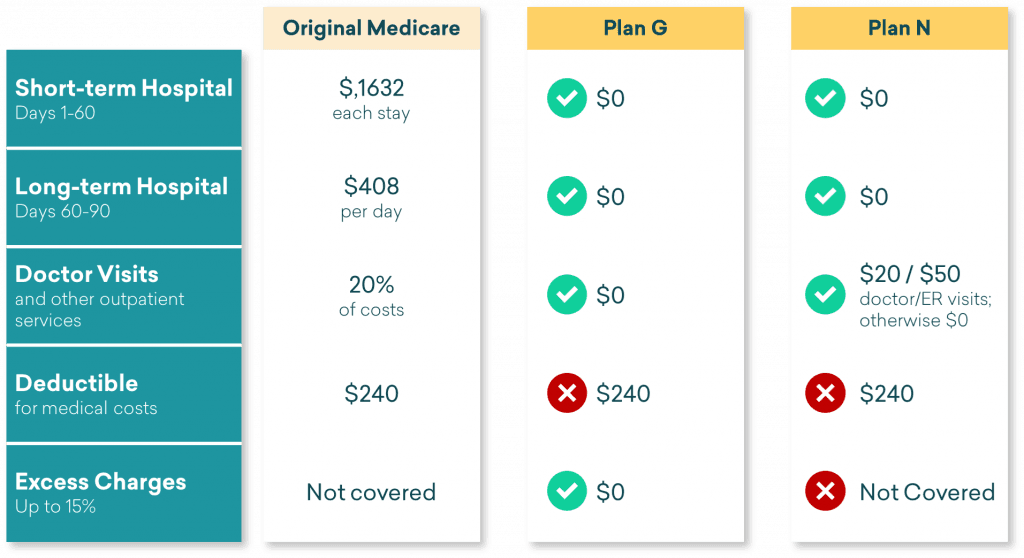
Plans G and N are the most comprehensive options for newly eligible Medicare beneficiaries, and the numbers back that up — they now account for close to ~80% of all new Medigap purchases according to Telos Actuarial.
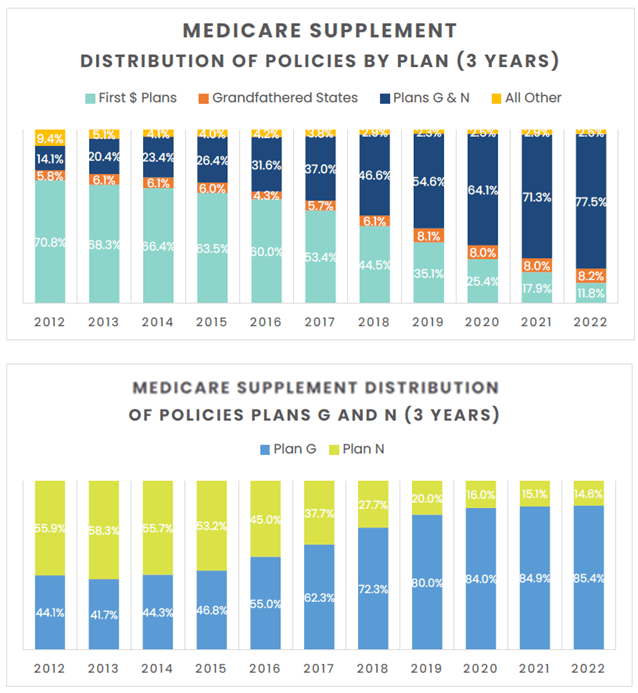
Distribution of Medicare Supplement Enrollment Table
| Plan Type | % of Total Medicare Supplement Enrollees |
| Plan F | 46% (No longer available for newly-eligible Medicare beneficiaries) |
| Plan G | 27% |
| Plan N | 10% |
| Plan C | 4% (No longer available for newly-eligible Medicare beneficiaries) |
| Plan I | 2% |
| Plan A | 1% |
| Plan B | 1% |
| Plan D | 1% |
| Plan K | 1% |
| Plan L | <0.5% |
| Plan M | <0.5% |
| Other | 6% |
Frequently Asked Questions
What is the enrollment process for Medigap plans?
- Enroll in Original Medicare (Part A and Part B)
- Compare Medicare Supplement plans sold in your state
- Select the plan that meets your needs
- Let the licensed Medicare experts at CoverRight work with you to fill out and submit an application.
You can apply for a Medicare Supplement plan at any point after you have both Medicare Part A and Part B. One important caveat: if you're applying outside your Medigap Open Enrollment Period, insurers are allowed to review your medical history, ask detailed health questions, charge you more, or even deny coverage altogether. This process is known as medical underwriting — and it's a significant reason why timing your enrollment thoughtfully matters.
Can I switch from one Medicare supplement plan to another?
Yes — but with an important catch. Outside of a period where you hold "guaranteed-issue rights," switching plans means going through medical underwriting. The insurer will review your health profile and application, and they reserve the right to accept or reject your request based on what they find.
If you are in a period where you have "guaranteed-issue rights," however, the insurance company that sells the Medicare Supplement plan:
- Must cover all of your pre-existing conditions
- Note that despite this, in some cases, you might have to wait up to six months before those conditions are covered
- Cannot require medical underwriting
- Cannot charge you more for your policy because of health reasons
- Cannot deny you coverage
"Guaranteed-issue rights" are Medigap protections that give you the right to enroll in any Medicare Supplement plan offered by any insurance company in your state, regardless of your health status.
How does Medicare Supplement plan pricing work?
Insurance companies have flexibility in how they set monthly premiums for their Medigap plans — and understanding those methods can make a meaningful difference in what you'll pay over time.
They can use any of the three ways to set premium costs:
- Community rating: Everyone who buys the same plan pays the same premium, regardless of age. Rates may rise over time due to inflation, but your individual age won't trigger an increase.
- Issue-age rating: Your premium is locked in based on how old you are when you buy the plan — cheaper at 65 than at 70. Once set, it won't go up simply because you get older, though inflation can still push it higher.
- Attained-age rating: Your premium reflects your current age at all times. These plans can look attractively priced for younger enrollees — but they tend to become increasingly expensive over time, compounded by both aging and inflation.
Before committing to any Medigap plan, always ask the insurer which rating methodology they use to price their premiums. It's a small question with long-term financial consequences.